
Neighborhood coffee shops and craft breweries have seen a noticeable increase in lawsuits recently. These are not large national chains with in-house legal teams. They are community-based businesses—often operating in older buildings—that may not know they are violating the law until they are served with a lawsuit.

Under the Americans with Disabilities Act (ADA) and California’s Unruh Civil Rights Act, businesses that are open to the public must provide accessible paths of travel, seating, restrooms, service counters, and parking. Even technical violations—such as a bathroom mirror mounted an inch too high, a restroom door requiring too much force to open, improper slopes at an entry ramp, or exterior dining tables without adequate knee clearance—can trigger litigation.

Coffee shops and breweries are particularly vulnerable because of:
Few states present greater ADA litigation risk to medical practices than California. In recent years, plaintiffs and ADA rights advocates have increasingly targeted medical facilities across the state, often filing high-volume lawsuits based on technical accessibility violations. Many practice owners are caught off guard, believing they are either compliant or too small to attract attention. In California, neither assumption is safe.

California is unique because ADA claims are almost always paired with the Unruh Civil Rights Act, which allows plaintiffs to recover statutory damages—typically $4,000 per offense, injunctive relief, and attorneys’ fees. This financial incentive has made California a hotspot for lawsuits against healthcare-related businesses of every size.

These claims are not limited to hospitals or large clinics. Targeted practices include physicians’ offices, internal and family medicine practices, dentists and orthodontists, oral surgeons, veterinarians and animal hospitals, physical therapy and chiropractic offices, mental health providers, psychologists and psychiatrists, urgent care centers, imaging and radiology facilities, dialysis centers, podiatrists, optometrists and ophthalmologists, audiologists, outpatient rehabilitation centers, fertility clinics, pain management practices, ambulatory surgery centers, addiction treatment facilities, medical spas and aesthetic salons, cosmetic and plastic surgery offices, acupuncture clinics, and specialty outpatient providers.

If you own a business in California, chances are you’ve heard about serial ADA litigants. This isn’t a coincidence. California is widely considered ground zero for serial ADA litigation. But why here? And what can you do to protect your business?

California’s Laws Make ADA Lawsuits More Attractive to Plaintiffs

The Americans with Disabilities Act (ADA) allows for injunctive relief, which means a court can order you to fix violations, but does not award plaintiffs damages. California law changes that. Under the Unruh Civil Rights Act and the Disabled Persons Act, plaintiffs can recover statutory damages of $4,000 per violation, per visit, plus attorney’s fees. California also does not have a blanket pre-suit notice requirement. Lawsuits can be and frequently are filed immediately, with no warning.

Section 55.54 Protections

For years, California businesses and their organizations have been trying to rein in the plethora of ADA lawsuits, particularly those filed by a handful of plaintiffs and their law firms to curb litigation abuse. Those trying to curb ADA litigation abuse have made several apparently important inroads.

One such inroad designed to curb litigation abuse is California Civil Code Section 55.54 which was enacted to provide protective measures against serial ADA lawsuits filed by “High Frequency Litigants.” If the plaintiff is a high-frequency litigant, as defined by California Code of Civil Procedure Section 425.55(b), then a defendant may seek a 90-day stay of the litigation, and an Early Neutral Evaluation. A high-frequency litigant is defined by a plaintiff who has filed 10 or more complaints alleging construction-related accessibility violations within the 12-month period immediately preceding the filing of the complaint. The process is incredibly simple, and requires the filing of a single form, checking off a few boxes. The most important rule is that the Section 55.54 application must be filed before or concurrently with the Answer, or responsive pleading, to the Complaint.

The goal of the Early Neutral Evaluation, and the 90-day stay, is for parties to reach early settlement. The Court will set forth the necessary procedures, documents, and goals for the early neutral evaluation. The Court may also require parties to conduct a joint inspection of the property in question.

Continue ›

So Cal Equal Access Group (So Cal) files ADA lawsuits almost on a daily basis. By and large, these lawsuits filed in Federal Court focus on the lack of accessible parking, inaccessible paths of travel to the building entrances, inaccessible entry doors, transaction counters that are excessively high and bathrooms that fail to comply with the ADA and the California Building Code (CBC). Lately, the firm has set its sights on the auto repair industry in the greater Los Angeles area. The law firm has filed suits on behalf of Larry Dunn, Jardine Gougis, Cesar Acevedo and Moses Villalobos, among others.

These lawsuits are typically filed against building and business owners related to properties built long before the ADA was enacted in 1991. Under the ADA both building owners and business operators are jointly and severally liable to the disabled plaintiff which means the plaintiff can sue either the business owner or building owner or both. Of course, landlords typically place responsibility on the tenant for indemnification for violations of law in the operation of their business through their leases. However, this legal chestnut is of little moment to the plaintiff’s lawyers who sue both the landlord and business operator. They typically sue the landlord who may have no idea that these ADA and CBC violations exist. Landlords typically tender the defense and indemnification to the tenant which only works if the tenant has the wherewithal to pay to defend both parties. Continue ›

In 2023, more than 1.4 million plug-in electric cars were sold in the U.S. The electric vehicle share of the total U.S. market was 7.6%, which is up from 5.9% the prior year, and expected to hit 31% by 2050. Given these numbers, it is inevitable that the motor vehicle industry will become fully electric, and the U.S. Access Board has taken strong note of this shift in the industry.

On February 14, 2013, the Access Board issued a notice of intent to establish an advisory committee on electric vehicle charging stations (“EVCS”) to create a proposed set of rules for accessible design. The Access Board has already accepted comments and input from the public on this issue, and as recently as January 31, 2024, held a meeting to discuss the finalization of its proposed rule on EVCS accessible design. In early February 2024, the Access Board voted to submit the draft rule text to the Office of Management & Budget (“OMB”), and the rule is currently under OMB review, which is the next step in the rulemaking process. If the rule is approved by the OMB, the Desk Officer will notify the appropriate Federal Register Liaison Officer (“FRLO”) that the rulemaking has been approved for publication in the Federal Register. Continue ›

Marty Orlick, Chair of JMBM’s ADA Compliance & Defense Group, was recently interviewed by ABC7 for a news report regarding the impact of serial ADA litigants on small businesses. The segment focused on a group of businesses in Santa Paula, California, who have been hit with lawsuits alleging violations of the Americans with Disabilities Act. The significant financial penalties imposed by these lawsuits threaten to close already struggling stores and restaurants.

During the segment, Marty discussed the California Unruh Civil Rights Act which requires businesses and public accommodations to provide equal access to their services and facilities. He explained that the Unruh Act “allows a plaintiff to recover $4,000 per occurrence every time they went to a particular business, or every time they thought of going but they realize there were barriers and they couldn’t get served.” The Unruh Act is often abused by serial plaintiffs who file hundreds of lawsuits every year, each claiming thousands of dollars in statutory damages.

These serial lawsuits can be incredibly damaging for businesses and are the antithesis of genuine legal action by advocates trying to make their communities more accessible.

You can watch the full ABC7 news report here.

Continue ›

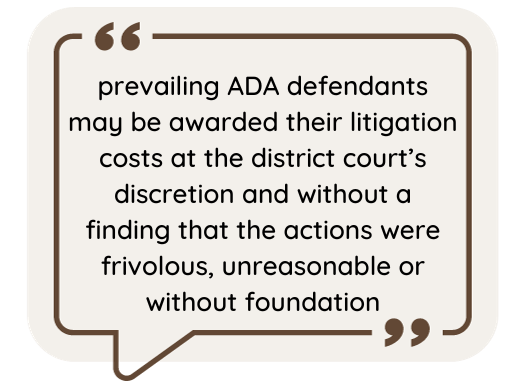
The prevailing wisdom in Americans with Disabilities Act litigation is that defendants who successfully prevail in ADA and Unruh Civil Rights Act lawsuits cannot recover their attorneys’ fees or defense costs. This prevailing wisdom compels most businesses to settle, rather than pursue a meritless case to summary judgment or trial. The tide may just be changing as more courts are awarding successful defendants their attorney’s fees and defense costs.

ADA-Blog-Quote

As we recently posted, a JMBM client was awarded over $100,000 in attorneys’ fees and costs in two separate cases. The first award of fees and costs was against high frequency litigant Orlando Garcia, and the second award was against the law firm representing him, the Center for Disability Access. Garcia and the Center for Disability Access appealed the awards; however, our clients will nevertheless seek to enforce the judgments pending the appeals. Continue ›

Today, the US Access Board announced that it is seeking final public comment on its newly proposed Americans with Disabilities Act (ADA) guidelines for the use of lower transfer heights for medical diagnostic equipment in medical diagnostics and treatment. The US Access Board is the federal organization that develops guidelines for the ADA. It works with professionals and advocacy groups to develop guidelines for various aspects of the ADA to provide greater access to goods and services. The Access Board is required to seek public comment before finalizing its proposed guidelines. After receiving public comment, the Access Board presents its proposed guidelines to the Department of Justice (DOJ) which then adopts all or part of the proposed guidelines into the ADA.

The Access board has been working for some time on the development of formal guidelines for lower transfer heights of medical diagnostic equipment. Once implemented, these guidelines will have an immediate impact on diagnostic equipment manufacturers, hospitals, clinics, and doctors’ offices throughout the country. The lower height requirements are intended to provide easier transfer for patients using wheelchairs, walkers, or other assistive devices. These diagnostic devices typically include, among other things, examination tables, scanning devices, and chairs for diagnosis.

Historically, medical diagnostic equipment (MDE) has been, and continues to be, inaccessible to many people in wheelchairs, which can lead to misdiagnosis or barriers to basic care and examinations. Continue ›

On June 12, 2023, the California Assembly’s Judicial Committee re-drafted the content of an existing bill, AB1757, to pertain specifically to website accessibility and the adoption of the Web Content Accessibility Guidelines (“WCAG”) 2.1 into disabled access law. AB1757 specifically permits plaintiffs the right to sue businesses if the business’s website fails to “meet all of the Success Criteria set forth in the” WCAP 2.1 guidelines. Furthermore, AB1757 also allows the business to sue its website developer for any of these failures.

Most significantly, a plaintiff who prevails under AB1757 will be entitled to collect all damages, including, but not limited to, any statutory damages and attorney’s fees paid as a result of a lawsuit.

Why is This Significant for Not Only California Businesses, but Potentially Every Website Owner in the U.S.?

Because the Americans with Disabilities Act (“ADA”) does not have official guidelines regarding website accessibility, it is very possible, if not inevitable, that AB1757’s impact will stretch far-beyond California law, and potentially be adopted as the governing website accessibility guidelines of the entire nation.

Who Does AB1757 Apply To? Continue ›